
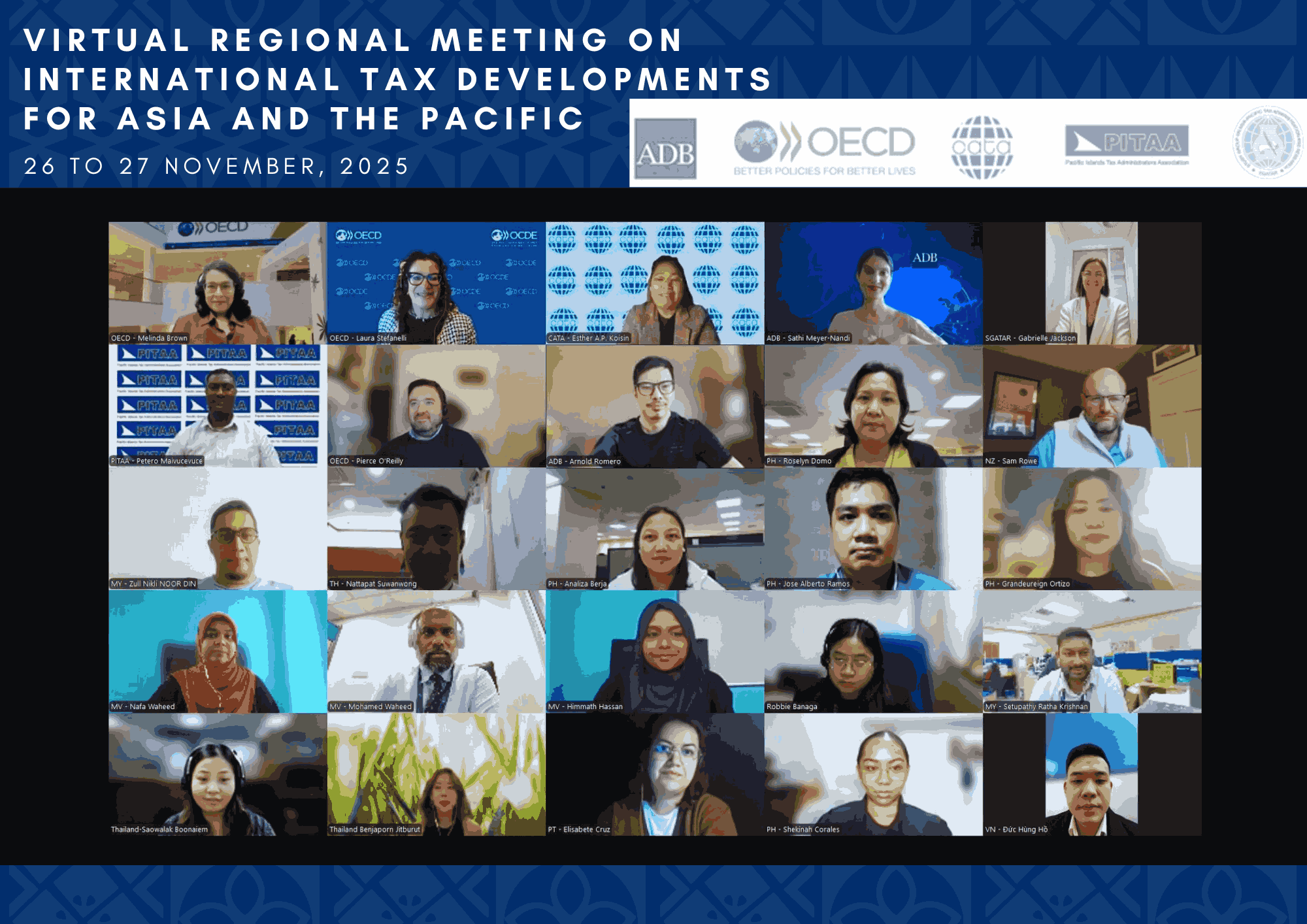
The Pacific Islands Tax Administrators Association (PITAA) participated in the Virtual Regional Meeting on International Tax Developments for Asia and the Pacific held from 26–27 November 2025, co-hosted by the OECD, ADB, CATA, SGATAR and PITAA. The meeting brought together tax policymakers and officials from across the Asia and the Pacific region to examine current global tax developments and their implications for developing economies.
PITAA Head of Secretariat, Mr. Petero Maivucevuce, delivered opening remarks on behalf of the Pacific, noting the importance of ensuring the region’s unique context is reflected in global tax discussions. He acknowledged the OECD’s ongoing coordination of the event and highlighted that seven PITAA member countries registered to participate, demonstrating the Pacific’s growing engagement in international tax dialogue.
“Our member states are not just small island developing states; we are large ocean states,” he said, emphasising shared challenges such as narrow tax bases, reliance on a few key sectors, and the pressures of the digital economy. He also underscored the region’s progress, noting that Pacific tax administrations have strengthened cooperation, advanced digital transformation, and continued to champion their interests within the Inclusive Framework on BEPS.
Throughout the two-day event, participants explored topics central to domestic resource mobilisation and tax administration strengthening. Sessions addressed the relationship between tax, inequality and growth, and examined the growing impact of global mobility on permanent establishment, tax residence, and the taxation of employment income. Discussions also focused on the need to simplify cross-border taxation to enhance certainty and reduce compliance burdens.
Country representatives shared practical strategies for tackling tax avoidance, offering insights valuable for small island administrations with similar capacity constraints. On the second day, OECD experts provided updates on BEPS 1.0 peer review streamlining, the decade-long progress of the BEPS initiative, and the introduction of Amount B aimed at simplifying transfer pricing for baseline marketing and distribution activities. Further updates covered the implementation of GloBE rules under the Global Minimum Tax, the development of safe harbours, and the Subject to Tax Rule (STTR), designed to protect the taxing rights of developing countries.
Reflecting on PITAA’s role as a co-host, Mr. Maivucevuce stressed the importance of collaboration and representation.
“This meeting is not only a platform to be informed, but also to inform,” he noted. “Our voice is essential to ensuring that international tax standards are practical and equitable for all economies, including those in the Blue Pacific.”
The meeting concluded with closing remarks from all co-hosts and a shared commitment to continued cooperation as jurisdictions adapt to the evolving global tax landscape.